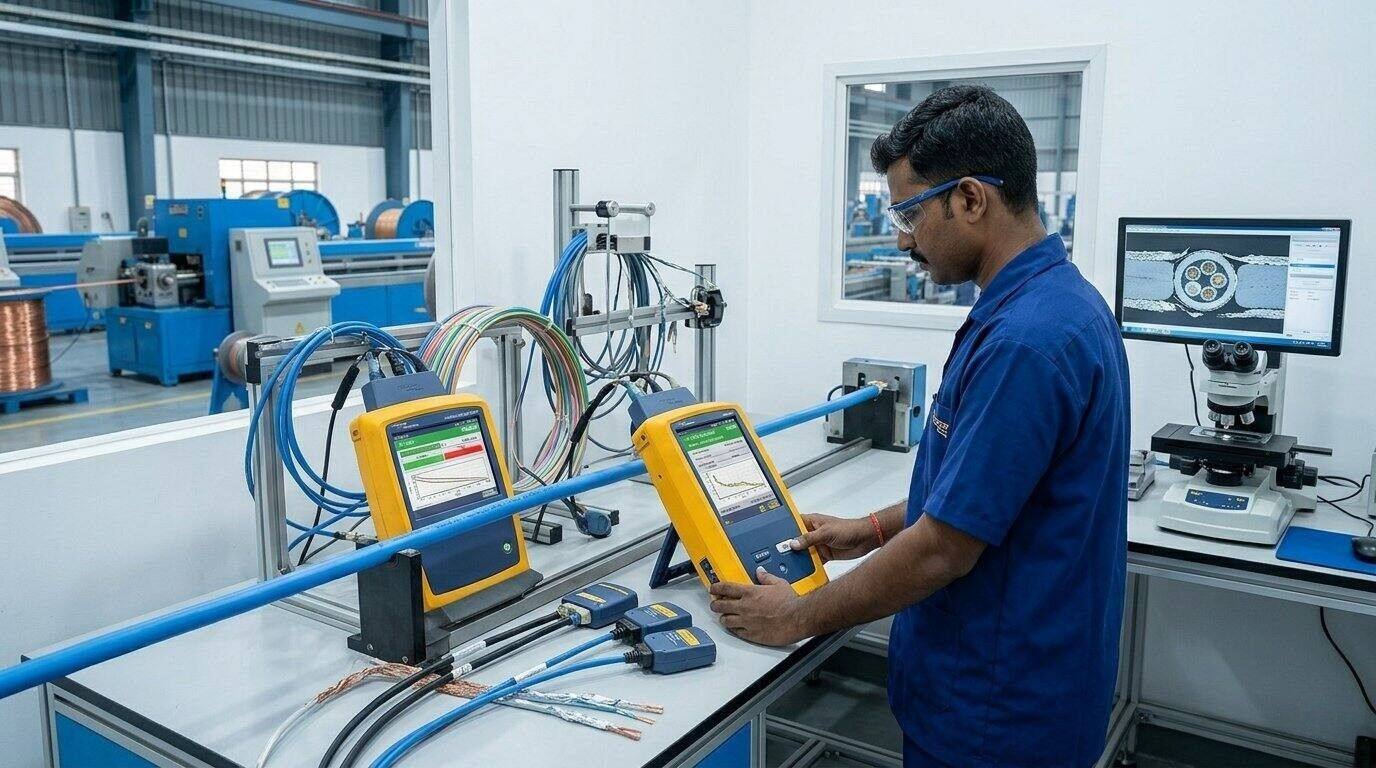
Most cable suppliers can produce a test report that says PASS. The useful information is in the detail: how much margin the cable has, where in the frequency range it is tightest, and whether the next batch looks the same as the last one.
Is it a component test or a field test?
Component (cable) test reports come from the manufacturer's lab, usually on a 100-metre length, and are measured against the cable requirements of TIA-568.2-D or IEC 61156-5. Field tests by installers measure a permanent link or channel — cable plus connectors — against link or channel limits. The numbers are related but not interchangeable, so check which limit set the report uses.
What does each parameter measure?
| Parameter | What it measures | What it tells you |
|---|---|---|
| Insertion loss (IL) | Signal lost along the cable | Conductor size and insulation consistency; rises with frequency and temperature |
| NEXT | Crosstalk between pairs at the near end | Pair twist and geometry control |
| PS NEXT | Combined NEXT from all other pairs onto one pair | The real-world crosstalk a pair experiences |
| ACR-F / PS ACR-F | Far-end crosstalk relative to the received signal | Pair geometry along the full length |
| Return loss (RL) | Signal reflected by impedance variations | Insulation diameter and capacitance stability |
| TCL / ELTCTL | Balance of each pair | Immunity to and emission of noise |
| Propagation delay and skew | Signal travel time and the difference between pairs | Required for 10GBASE-T |
| DC resistance and unbalance | Conductor resistance and its pair balance | Important for PoE heating and power delivery |
For alien crosstalk, CAT6A reports may also include PS ANEXT and PS AACR-F, measured on a bundle of cables, typically a six-around-one configuration.
What is margin, and why does it matter?
Margin is the difference between the measured value and the limit at each frequency. For loss and crosstalk parameters, positive margin means the cable is better than the limit. A cable that passes with 0.5 dB of NEXT margin leaves almost nothing for the connectors, patch cords and installation workmanship that follow; a cable with several dB of margin protects the installed channel.
Look at two numbers for each parameter:
- Worst-case margin — the smallest margin anywhere across the frequency sweep, on any pair.
- Worst-case value — the measured value at the frequency where the result is closest to the limit.
What frequency range should the report cover?
For CAT6A, the sweep should run from 1 MHz to 500 MHz. Many marginal failures appear only at the top of the range, so a report that stops early is incomplete.
Red flags to watch for
- Results marked with an asterisk or as a marginal pass — they fall within the tester's accuracy band.
- A worst-case margin that is consistently at the same pair or frequency across batches, which often points to a specific process issue.
- Large differences between qualification samples and production batches.
- Reports without equipment details, calibration dates or batch identifiers.
Use reports to track consistency
One report tells you about one length of cable. A series of reports tells you about the process. Ask your supplier for batch-level reports and plot worst-case margin over time; a stable trend is the best evidence that you will not face surprises at certification.
Channeltech tests every batch to TIA-568.2-D and IEC 61156-5 and shares batch-level reports, including margin data, before shipment. Request a recent report through our contact page or download the datasheet for your construction.