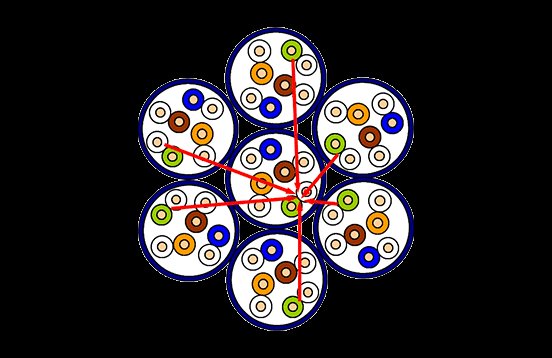
When network engineers evaluate CAT6A cable for datacenter or enterprise deployment, NEXT (Near-End Crosstalk) is often the first parameter they check. But in real-world high-density installations, the dominant performance limiter isn't crosstalk within a cable — it's Alien Crosstalk (AXT) between adjacent cables in the same pathway.
Why AXT Matters More Than You Think
AXT is the electromagnetic coupling between pairs in different cables running in parallel. In a 48-port patch panel with 24 cables bundled together over 90 metres, AXT can degrade 10GBASE-T performance even when every individual cable passes component-level NEXT testing. This is the failure mode that catches engineering teams off guard during field certification.
The Physics of High-Density Bundling
When cables are tightly packed in conduit or cable trays, the electromagnetic fields from each pair extend beyond the cable jacket and couple into adjacent cables. The severity depends on cable-to-cable spacing (which is near-zero in filled conduits), parallel run length, and the cable's inherent AXT suppression capability.
How Cable Construction Affects AXT
Three construction factors determine AXT performance: pair twist geometry (varied lay lengths prevent systematic coupling between adjacent cables), shielding effectiveness (S/FTP provides the best AXT isolation, but well-designed U/UTP can achieve Class EA compliance), and cable diameter (larger diameter creates more spacing between the conductor pairs and the jacket surface, reducing external field strength).
The Channeltech Approach
Channeltech's pair geometry design achieves AXT compliance without requiring excessive cable diameter. Our CAT6A U/UTP at 7.2mm diameter meets ANSI/TIA-568.2-D AXT requirements. This matters in high-density installations where conduit fill ratios are critical. For environments where maximum AXT isolation is needed, our S/FTP variant provides +6.6 dB margin above standard at 500 MHz — verified across production batches.
Practical Recommendations
For installations with more than 24 cables in a single pathway over distances exceeding 70 metres, we recommend either CAT6A S/FTP (maximum AXT margin) or our AXT-compliant U/UTP with controlled pair geometry. Our engineering team can provide AXT simulation data for specific installation configurations upon request.